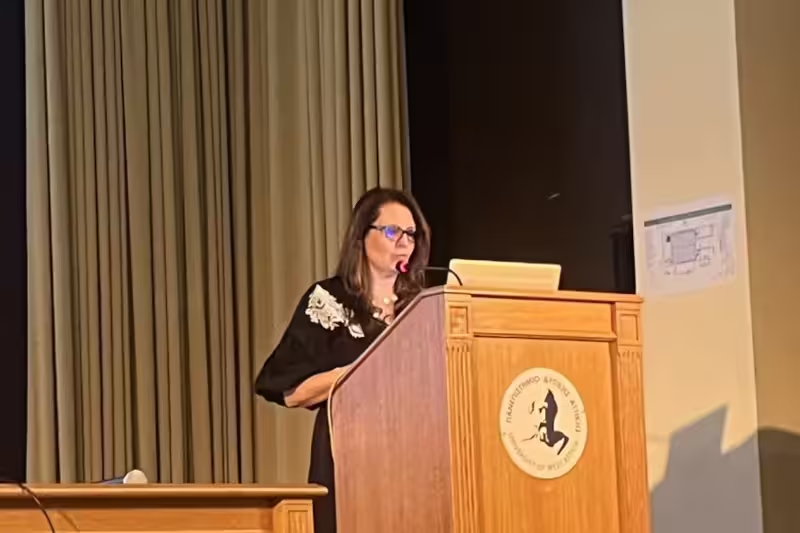
Having a child is everyone’s right
Lina Evgeni, Director of Cryogenia: IVF should not be considered taboo.
Editing: Elianna Spyropali
As the founder and scientific director of the Cryogonia Sperm Bank, a reproductive biologist, and as a mother, Lina Eugenis has a personal goal: To share the joy of childbearing with more and more people. She is a graduate of the Department of Biology of the National and Kapodistrian University of Athens, holds a Master of Science (M.Phil) from the University of Nottingham UK and a PhD from the Department of Medicine of the Democritus University of Thrace.
Specializing in the examination of conventional-functional sperm parameters and sperm-origin tissue cryopreservation, she has more than 20 years of experience in the field of Laboratory Spermatology.
She is certified by the European Society for Human Reproduction (ESHRE) as a trainer for basic semen analysis, with active participation in scientific events, conferences and authoring. Although worrying, she explains that there is a huge infertility issue throughout the western world where, among the various alternatives that can be proposed, there is the solution of sperm banking:
– What we can offer as a unit, as a “cryopreservation bank of genetic material” to those who cannot procreate with their own biological material or to those who want to cryopreserve their own genetic material, is to be able to start their own family in the future in such a way as to avoid possible risks in special cases, for example in people who at a particular stage of their life have a serious disease or need to undergo strong treatments.

Mrs Evgeni continues to impress us when we hear her tell us that Biology is a field of creation, and close to her one contributes to the creation of a life, one becomes a family with some of one’s fellow human beings, which makes it exciting!
In her words, “IVF should in no way be considered taboo nowadays“.
It is a way so that an egg can unite with a sperm creating that embryo which will later grow into the child of the family who with love, conscience and dedication followed the necessary procedures of assisted reproduction.
The first part of the interview:
“Anonymity” is one of the main features of Greek legislation regarding sperm donation, both in relation to the donor and the recipient.
-The evaluation in relation to interested donors is very strict and time-consuming…
“The smallest percentage of prospective volunteers are those who are suitable to enter a sperm bank program. Specifically in our high quality bank run as Cryogenia, 8 percent are the ones who get into the final donation program from the initial candidates. This means that the filters of the process are too many, complex and very strict by a team of associate scientists including geneticists, clinical andrologists, psychologists…

As Mrs Evgeni mentions:
“In relation to the age limit, we as a bank set the age limit of 18-35 years old, since up to 35 the fertilizing potential of sperm is safer, better and more successful with the possibility of eliminating the occurrence of birth defects. It is an urban myth that a man can safely procreate at much older ages without the risk of DNA mutation , segmentation or even mutations that can create a poor quality embryo or even a miscarriage.”
Of course, the question ‘Why is the man unable to inseminate’ can have many answers. Male infertility could be related to the presence of pathological conditions such as cryptorchidism, varicocele, hormonal disorders or other abnormalities of the urogenital and/or other systems, e.g. infections, inflammation, diabetes mellitus, kidney disease, cancer. It is also associated with the presence of genetic disorders, e.g. chromosomal or gene disorders causing endocrine or genital malformations. It could also be caused by taking drugs or strong therapeutic regimens that cause damage to sperm production (chemotherapy, radiotherapy). In addition, daily life habits impair sperm quality, such as smoking, alcohol, exposure to radiation or high temperatures through the work environment (e.g. sedentary lifestyle, computer radiation, radar, hot showers, wearing tight underwear, etc.). As well as the psychological stress that characterises the modern rhythm of life. Finally, advancing age (even after 35) reduces the male fertility potential.
This is why it is good for men while they are young to do the simple, easy and well-tested procedure of “sperm cryopreservation” after a spermogram.

When choosing the donor, the phenotype of the family environment in which the child will grow up should be taken into account, so as not to create future conflicts that will embarrass either the parents or the child.
For example, when a father-recipient with infertility comes to us to choose a donor who will bring his own offspring to life with his own characteristics and features, certainly belonging to the environment of the Greek society will help him to avoid any particular discrepancies in the family he will create in the future.
Watch the second part of the interview:
– “Our role with any recipient is to get into their psychological state by understanding the psychological stress they are experiencing when making a choice and after listening to them, learning them, understanding them… directing them to the right choice by making the right match in such a way that if they would have chosen themselves without having gotten the information from us, they would have ended up with the same result. The point is compatibility through the holistic approach when the health parameters have been eliminated.”
Touching is the video of a recipient of Cryogonia who travelled from the USA to Greece to undergo a donor assisted reproduction procedure and just a few years later… publishes a video with her two-year-old boy who has even created her own personal website in America to encourage women who want to experience motherhood through a sperm bank:
https://www.fertilityforreal.com/blog

-How does Mrs. Evgeni feel as a human being when a child is born through the hands of Cryogenia?
“The donors, although they never find out who the recipient was, are all young people aged 19-35 years old, who are strongly motivated by a sense of the need to give back to society.
The phenotype, external characteristics such as hair colour, eye colour, height, weight, educational level, certain habits, personality traits, are what help us to find this match once we have ruled out possible abnormalities between the donor’s and the recipient’s DNA through our geneticists’.
Many of these people have told us that the reason they have come is precisely because a relative or close friend has experienced infertility. And they have a strong need within them to help create a family for their fellow human being.
Many of them have actively joined the offer because they are also blood donors. They are open-minded, sensitive individuals who will take on all the responsibilities of the overall necessary process.

When the desired result comes to us from the people who have successfully completed their effort (whether it is a couple or a single parent family) that is the greatest satisfaction for us.
Even in her statement about the value of the single-parent family, Mrs. Eugene speaks to us first as a woman and then as a scientist:
– “It is my absolute position with regard to the creation of a single-parent family: Every mother has the inalienable right to experience motherhood as she wishes.”
With regard to COVID-19 and its effects, there are clear instructions from the National Public Health Organization and the National Authority for National Reproductive Studies that after the first wave of COVID-19 it became possible and permitted to attempt assisted reproduction and embryo transfer as long as those undergoing such an attempt have been evaluated negative to the virus at least at the time of the procedure.
The risk in these cases was precisely because we did not know whether in the first trimester of virus emergence, the virus was capable of passing into the embryo causing damage. As time goes by, more data is recorded and, as long as everything is followed according to regulations, embryo transfer, conception , pregnancy and childbearing are natural stages in the continuity of our evolution and in no case is the embryo at risk until it is born.
Of course, there is still a lot to be seen about Covid by staying within the guidelines of the competent authorities.
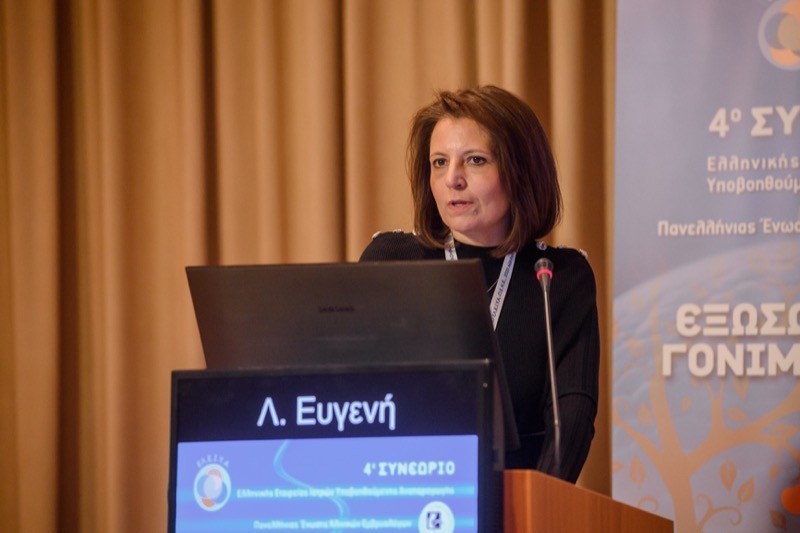
In the work of every person involved in the science of Life like Mrs. Lina Evgeni and her team, Cryogonia… there are bright spikes that come to the surface and for this reason… they are able to be attributed with optimism and a promising smile to future parents as one of the most… warming aspects of our lives.
https://www.hellenicdailynewsny.com/el/in-house-greece/3860-i-anagki-na-viosei-mia-gynaika-i-ena-zevgari-to-goneiko-rolo-einai-anafaireto-dikaioma?fbclid=IwAR13uxQiSBv8LYY7IsViGofsK1Pj-fEDWfkqqiG0USk3FfJVtRL4QXDvuFU